REVIEWS
Venutian Wetland:
“Another musical high point was Venutian Wetland by viibra, a flute septet founded to support an album and subsequent tours by Björk in 2016. The group coaxed tones and notes out of instruments that sounded less like flutes and more like mouthpieces in transmission with other kinds of language. Of the musicians, who moved together as a chaotic yet tightly choreographed chorus line, the show notes read: “Invisible flows of matter weave between them—thick, unstoppable—becoming the driving forces that reshape form, function, and being.”"
“Another example of ecological relationality is the flute septet, viibra, that formed in 2016 for Björk’s Utopia. viibra transformed the environment of the concert venue Harpa by arranging chairs in a circle with two openings for the group’s procession. The redesign, according to the concert ephemera, is imagined as a “Venutian Wetland” where the “self-organizing collective of co-existing lifeforms…exist in a fragile symbiosis where the line between individual and whole dissolves, and adaptation is not a choice but necessity.” In this setting, the group blew into flutes in a percussive way, where the breath barely resolves into notes. Their polyphonic respiration functioned like wind, creating a call-and-response rhythm that rippled through space. At one point in the performance, the performers went behind the audience with one flutist in the middle, creating a sphere of sound.”
“One of the most special highlights of the program was Venutian Wetland by viibra, an ensemble of seven flautists who had been founded to accompany Björk on her albums and tours since 2016. In their performance, the flutes were not only heard as musical instruments but as wind voices from another language, in a choreographed, almost ritualistic movement.”
Supraseether:
Martin Longley for The Brooklyn Rail
“The more impressive Supraseether worked within similar territory, but more aroused, with massive kettle drums drag-scraped, and the strings of one piano also rubbed harshly. It was a very subtle development, although growing in assured strength, the percussion skin-rubs eventually sounding like fighter planes above, gongs going to siren level, howls and groans along with the smaller drums deployed by the pianists. Tin whistles and bird-callers made a late appearance. This was still a form of drone music, though not typical of the form.”
Peter Margasak for The Wire
“The New York ensemble Yarn/Wire play two excellent concerts, premiering new pieces by and with trumpeter Nate Wooley - an austere work built around the work of Scottish poet Nan Shepherd featuring the extraordinary vocalist Tara Khozein - Bergrún Snaebjörnsdóttir, and Jonah Haven.”
Andreo Michaelo Mielczarek for Seismograf
“At a later concert, Yarn/Wire performed a new work by Icelandic composer Bergrún Snæbjörnsdóttir. Pianos and percussion created a sonic space of humming resonances, fragile surfaces, and piercing whistle tones, as if the music were drifting up from an unknown underwater world.”
“…new work by Bergrun Snaebjornsdottir. Pianists Laura Barger and Julia Den Boer handle their instruments not—or rarely—with the keyboard, but with nails, knobs, and strings. Percussionists Russell Greenberg and Dustin Donahue slide and scrape on metal, the percussion, or the instruments of their colleagues. The final composition could serve excellently as a soundtrack for a horror film due to the careful build-up of rhythms and the measured introduction of chilling sounds, right up to the four-part screeching whistle with which the piece concludes.”
//
“en nieuw werk van Bergrun Snaebjornsdottir. Pianisten Laura Barger en Julia Den Boer hanteren hun instrument niet of zelden met het klavier, maar met nagel, knop en snaar. De percussionisten Russell Greenberg en Dustin Donahue schuiven en schaven op metaal, de percussie of het instrument van hun collega’s. De laatste compositie kan uitstekend dienen als een soundtrack voor een horrorfilm vanwege de zorgvuldige opbouw van ritmes en gedoseerde introductie van ijzingwekkende klanken, tot aan het vierstemmige snerpende gefluit waarmee het stuk wordt beëindigd.”
Intraloper:
Weronika Bielecka for Glissando
“In almost complete darkness, we listened to Intraloper Bergrún Snæbjörnsdóttir for wind quartet. Although characterized by an extraordinary intensity that pushed the boundaries of safe listening, it was definitely one of my favorites. The piece clearly reflected inspiration from the Tibetan Book of the Dead and its themes of death and rebirth. Apparat presented a wide range of acoustic and electronic sounds: from barely audible, breathy, and extremely low to extremely high, sharp, stabbing, at times teetering on the edge of pain. It's difficult to even critically reflect on a work that evokes such powerful emotions and captures the totality of life and death. It was definitely a journey you can only undertake once. A work to be experienced rather than contemplated.”
//
“W niemalże zupełnej ciemności wysłuchaliśmy za to Intraloper Bergrún Snæbjörnsdóttir na kwartet instrumentów dętych. Mimo że charakteryzował się niezwykłą, przekraczającą granice bezpiecznego słuchania intensywnością, był to zdecydowanie jeden z moich ulubionych punktów programu. W utworze wyraźnie słychać było inspirację tybetańską Księgą Umarłych i podejmowaną w niej tematyką śmierci i odrodzenia. Zespół Apparat zaprezentował szeroki wachlarz akustycznych i elektronicznych brzmień: od ledwie słyszalnych, oddychających i ekstremalnie niskich do skrajnie wysokich, ostrych, kłujących, chwilami balansujących na granicy bólu. Trudno nawet o krytyczną refleksję wobec dzieła, które powoduje tak silne emocje i oddaje totalność życia i śmierci. Zdecydowanie była to podróż, którą można odbyć tylko raz. Dzieło raczej do przeżycia niż do przemyślenia.”
Andreo Michaelo Mielczarek for Positionen & Seismograf
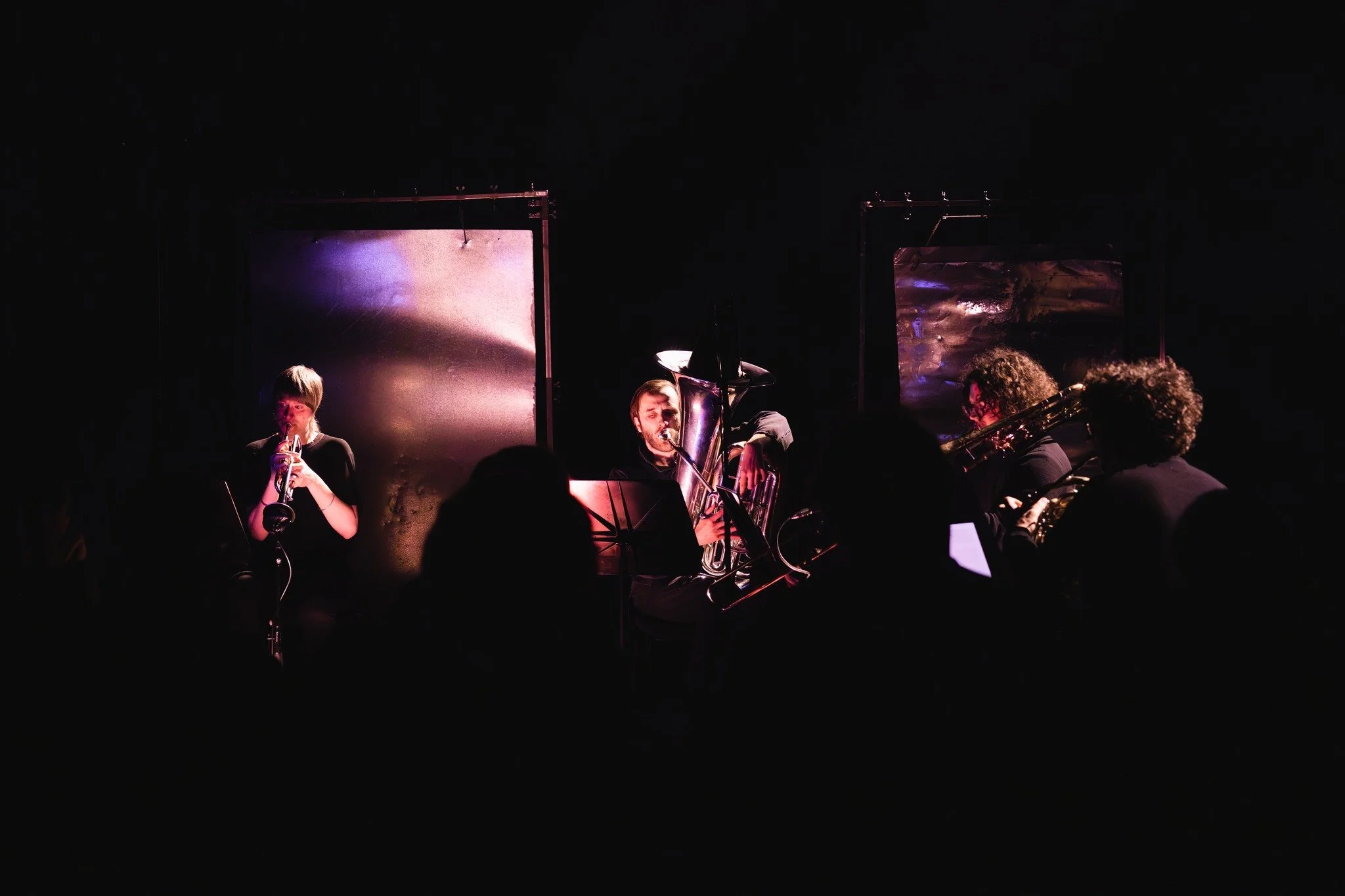
“The German brass quartet APPARAT gave the world premiere of Bergrún Snæbjörnsdóttir’s Intraloper. Behind the musicians hung metal sheets like silent co-performers. They answered back, set themselves in motion, vibrated and – together with electronics – added a raw, tearing resonance. In Harpa’s polished concert hall, the feeling of a temporary industrial warehouse emerged. The balance was exact: the dry clicks of the valves stood naked before the full brass sonority cut through the space with physical weight. The sound was unadorned – deeply material, cold and wildly compelling.”
//
“Das Berliner Blechlbläserquartett Apparat präsentierte die Weltpremiere von Bergrún Snæbjörnsdóttirs Intraloper. Hinter den Musikern hingen Metallplatten wie stumme Co-Performer. Sie reagierten, setzen sich in Bewegung, vibrierten und fügten - zusammen mit der Elektronik - der Musik rohe, eindringliche Resonanzklänge hinzu. Die elegante Atmosphäre des Konzertsaals der Harpa verwandelte sich vorübergehend in die einer Indurstriehalle. Die Balance innerhalb des Instrumentalensembles war präzise: Das trockene Klicken der Ventile trart deutlich hervor, bevor der volle Klang des Blechs mit physischer Wucht den Raum durchdrang. Der Klang war nicht schmückendes Beiwerk, sondern zutiefst materiell, kühl und ungemein fesseind.”
Amanda Cook for I Care If You Listen
“Some of the most impressionable moments of the festival were experimental works that came with little context, including Bergrún Snæbjörnsdóttir’s visceral and multi-sensory Intraloper. Walking into the hall, Apparat brass ensemble was bathed in ominous red light, shrouded in mist, and enveloped in hanging sheets of metal. After the lights went down, muted trumpet emerged from the white noise of the fog machine, and sputtering thumps of articulation came from trombone and tuba mouthpieces fully inside their players’ mouths.
As the quartet began to excavate something from deep inside the earth, their growing sound activated the metallic thunder sheets, first at a low roar, then at a buzzing rattle. The strategically delayed unsheathing of unmuted brass tone brought incredible power as the players were illuminated in stark white light. Inhalations and exhalations through the instruments sonically mapped their interiors, and the return to shimmering muted brass shifted the light to a warm golden hue. As the work kept us steeped in hushed sounds for prolonged periods of time, the moments that opened up were deeply satisfying and delivered a massive pay-off.”
Eva Yuki Mik for Reykjavík Grapevine
“One piece that keeps on reverberating long after its final note, is Bergrún Snæbjörnsdóttir’s Intraloper, premiered by brass ensemble APPARAT. Behind the musicians hang vibrating metal plates, illuminated by ominous red light. Before APPARAT even starts playing, the sound of vibrating metal already fills the space with suspense. Slowly the ensemble comes to life: snoring, whispering and stretching as if an organism is growing and pulsating in the room. The light switches to cold white and for the first time in the piece, the brass instruments fully utilise their sound. Sound continues to resonate through the metal sheets, even when the instruments are not playing. It is as if there is always something lurking behind the ensemble, a composition that happens in the margins.”
Tumi Árnason for RÚV:
“The best concert of the festival, in my opinion, was on Friday evening, when the German brass quartet APPARAT performed Bergrún Snæbjörnsdóttir’s Intraloper. During the piece, it almost felt as though we were experiencing something not meant for human perception, as if a gateway had been opened into another dimension. Using the instruments, she conjured utterly otherworldly sounds, which were amplified and sent through large metal plates hanging behind the performers.”
//
“Einir bestu tónleikar hátíðarinnar að mínu mati voru svo á föstudagskvöldinu, þegar þýski málmblásarakvartettinn APPARAT flutti verk Bergrúnar Snæbjörnsdóttur, Intraloper. Á meðan verkinu stóð fannst mér næstum eins og við værum að upplifa eitthvað sem væri ekki ætlað mannlegri skynjun, eins og það hefði verið opnað hlið inn í aðra framandi vídd. Með hljóðfærunum framkallaði hún fullkomlega framandi hljóð, sem voru uppmögnuð og send í gegnum stórar málmplötur sem héngu fyrir aftan flytjendur.”
Arnar Eggert for www.arnareggert.is
“I went to Myrkir Músíkdagar yesterday and enjoyed listening to a new work by the very talented and well-known Bergrún Snæbjörnsdóttir. A new piece, Intraloper, was premiered, performed by the German brass quartet APPARAT together with Bergrún, who enhanced the electronics at selected moments.
You walked into the Norðurljós Hall at Harpa; it was quite dark inside, and the quartet sat center stage in cool lighting. Behind each player hung a kind of metal plate. There was a faint rumbling underneath everything as you entered, and you genuinely weren’t sure whether the piece had already begun or not.
A quiet blowing began, underscoring an eerie atmosphere. The work sits on the boundary between music and sound art, though it leans much more toward the latter. But this is not dissonant or “noise” art—the sounds you heard played with the ears rather than bristling at them. The progression drifted mostly beneath and above, drawing you into a kind of meditative state. At one point the brass players sharpened their tone, but otherwise the piece seemed to pass over you—through you—somehow. I’m almost tempted to use the word “comfortable.” Gentle? Even if that may not seem fitting in a review of an experimental work.
APPARAT delivered 100%, but Intraloper is the result of a collaboration between Bergrún and the group, composed especially for the occasion of the festival. A truly beautiful and thought-provoking work—and it’s still marinating in me.”
//
“Fór á Myrka músíkdaga í gær og naut þess að hlusta á nýtt verk eftir hina mjög svo hæfileikaríku og vel kynntu Bergrúnu Snæbjörnsdóttur. Nýtt verk var frumflutt, Intraloper, en þýski málmblásarakvartettinn APPARAT sá um flutning ásamt Bergrúnu sem magnaði upp rafhljóð á völdum stöðum.
Maður gekk inn í Norðurljósasal Hörpu, vel dimmt var þar og kvartettinn sat fyrir miðbikið í svalri lýsingu. Aftan við hvern spilara hékk einslags málmplata. Það urraði smávægilega undir öllu er maður gekk inn og maður var hreinlega ekki viss hvort að verkið væri byrjað eður ei.
Hljóðlátur blástur hófst svo og undirstakk skuggalega stemningu. Verkið er á mörkum tón- og hljóðlistar og hallar í raun mun meira á hið síðarnefnda. En þetta er ekki óhljóða- eða hávaðalist (“noise”), það sem heyra mátti lék við eyrun fremur en að byrsta sig við þau. Framvindan dúaði þannig að mestu undir og yfir og dró mann inn í hálfgert hugleiðsluástand. Á einum stað hvesstu blásararnir sig en að öðru leyti leið verkið um mann – í gegnum mann – einhvern veginn. Ég er nánast kominn út í það að nota orðið “þægilegt”. Blítt? Þó manni finnist þetta ekki eiga við í umsögn um framsækið tónverk.
APPARAT skilaði sínu 100% en Intraloper er afrakstur samstarfs Bergrúnar og hópsins og var það samið sérstaklega í tilefni hátíðarinnar.
Virkilega flott og hugvekjandi verk og það er að marinerast í mér enn.”
Roföldur:
Robert Barry for The Wire
“The sound of Ore is close to a work played live upstairs on the Saturday night - remarkable, given the work is created entirely with a contrabass clarinet, soprano recorder and a selection of antique wooden birdcalls. Roföldur, co-composed by Bergrún Snæbjörnsdóttir and John McCowen (performed by the latter with tape accompaniment), is a work of extraordinary intensity. Even in its quiet moments, it seethes with feverish potency. The birdcalls, recorded at the Ina-GRM studios in Paris, have been processed and stretched into a silvery fog, closer to the feel of grit and slate than the feathered things its sources are designed to imitate. The contra practically barks, every breath a congeries of fissile multiphonics.”
Andreo Michaelo Mielczarek for Seismograf
”It was at Østre, however, that Borealis’ almost insistent niceness was truly challenged. In Saturday’s double bill, the ever-intriguing Bergrún Snæbjörnsdóttir, together with John McCowen, presented Roföldur. Here, the multiphonics of the contrabass clarinet grew into organic formations in the twilight of sound, until fragile bird-like tones – these small creatures with superpowers – forced their way into the dense sonic mass. Wow.”
Amanda Cook for I Care If You Listen
“Other highlights of the festival included Sonic Entanglements at Østre and Infinite Pollination at Bergen Kunsthall. Sonic Entanglements was the Saturday night double bill of Bergrún Snæbjörnsdóttir + John McCowen and Hilde Marie Holson + Mariam Gviniashvili. In Bergrún and John’s Roföldur, contrabass clarinet multiphonics emerged from white noise, first at the faintest whisper, then growing into earth-shattering, spectral explosions that threatened to rattle our bones from our bodies. Sound became vibration; McCowen’s foghorn of overtones transformed music from a sonic experience to a somatic one.”
“The most immersive listening experience of Borealis 2026 – theoretically much dryer, but thanks to the non-stop rain that fell throughout the festival that’s not really true – came at a concert titled ‘Sonic Entanglements’ in the club space of Østre. Both performances explored the interiority of sound, seeming to position us deep within the music, such that it overwhelmed and subsumed, providing an eye-of-the-storm-like revelation of intricate detail within massive quantities of energy.”…“Equally astonishing, and even more extreme, was Roföldur by Bergrún Snæbjörnsdóttir and John McCowen. Barely audible overtones emerged from the ambient noise floor, like half-asleep birds caressing sound. Abruptly this gave way to the most almighty blaze, a scalding, razor-edge of abrasive bass, no longer a focal point but everywhere. Here, too, inner details were revealed, the most startling being a tiny triad described by overtones, a seemingly implausible presence – so shockingly small and intimate in this overwhelmingly massive context – yet seemingly supported by everything looming over it. Contrabass clarinet and electronics melded together, utterly inseparable, they eased off, poised before blazing anew, the music now serving as a kind of sanctuary for birdsong-like trills and blips playing out within its vast walls of judder, and ultimately winning through. i’ve rarely heard such enormity and intimacy made to work so sympathetically and effectively. At this concert, finally, was everything that had been so conspicuously absent elsewhere at Borealis: risk, challenge, complexity, experiment, provocation – and above all, utterly stunning music.”
Karolina Dąbek for Ruch Mucyczny
“Many events encouraged relaxation and immersion in the sensuality of sound. From the club program, what stayed with me was Roföldur by Bergrún Snæbjörnsdóttir and John McCowen—a thoughtful composition with slowly unfolding structures of the contrabass clarinet (ranging from noise to dense spectral masses), heavy tones vibrating through the body, and a light ending featuring recordings of animal sounds.”
Skinweeper (album):
“Skinweeper, the first full-length album of compositions by Iceland’s Bergrún Snæbjörnsdóttir, is a raucous, earthy beast of an album, like tractor blades grinding through soil. Squawking clarinet multiphonics, crunchy scratch tone cellos, wailing horns, and clattering metallic percussion rasp through the mix as if they’d been buried for centuries and now dragged out of the earth to perform one last industrial symphony. The distortion-pedal guitars in your boyfriend’s metal band sound frankly lame in comparison. The record comprises three compositions, Areolae Undant (2017), Gleaning, Still (2018) and The Spilling Jars (2022), each one more gnarly sounding than the last. Each one features the clarinet-playing of John McCowen, a unique player determined to wrest a polyphonic sound from his essentially monophonic instrument, whether the damn thing likes it or not. His caustic contributions are a crucial part of the sound here. But ultimately this is Snæbjörnsdóttir’s world, a thrilling sampling of one of the most exciting and uncompromising new compositional voices in Europe right now.”
Peter Margasak for Best of Bandcamp
“This new collection of works from the Icelandic composer Bergrún Snæbjörnsdóttir traces a process of development beginning with the opening work “Areolae Undant,” which was made back in 2017 when she was still a student at Mills College in the Bay Area. The grainy, low-end work that heaves and sighs with low reeds and groaning cello was preceded by conversations between the musicians and composer to decide how each player should be scored, with parameters and tools to guide the improvisations to work together as an ensemble piece. At the center of the piece is the harrowing friction produced by veteran percussionist William Winant with metal objects and bass drum. The lines articulated around it by contrabass clarinetist John McCowen, English horn player Kyle Bruckmann, cellists Marissa Deitz and Theresa Wong, and percussionist Kevin Corcoran respond to a giant light controlled by Snæbjörnsdóttir as a kind of interface for the musicians. The following year she created “Gleaning, Still,” to put a spotlight on Winant’s sonic mastery, as series of ringing metallic cries and rumbles producing noise of unusually rich resonance and bite, with clarinetist McCowen adding subtle overtones that sustain and connect the percussive gestures. The final work, “The Spilling Jars,” was made in 2022, and kind of reimages the first piece with a much leaner, more direct palette, with percussionist Matthias Engler creating a similar sound world as Winant while McCowen and harpist Gunnhildur Einarsdóttir unfurl bracing upper register lines that seem to emanate from the bowed percussion. The album charts a fascinating progression of a single idea, honed and developed over time and shaped by shifting personnel.”
Arnar Eggert for www.arnareggert.is
“I have just finished listening to Bergrún's work, Intraloper, with eyes and ears, a premiere that took place at the recent Dark Music Days. The German brass quartet APPARAT performed with Bergrún, who amplified the electronic sound in selected places. A magnificent work on the border between music and sound art, but this was not noise art at all. What could be heard played with the ears rather than clashing with them. The progression was such that one was drawn into a semi-meditative state.
I had started Skinweeper before Dark Music Days and the nature of that work is different, so to speak. “Areolae Undant”, the opening work, grabs you from the first note or should I say sound? A harsh “industrial” tone and whether it was the focus or not, the work winds forward like an ocean that retreats from the shore before crashing back with force. A rhythmic work that draws you in and disappears, draws you in and disappears. A haunting construction that explodes into the air.
“Gleaning, still” is not unlike it, but it sharpens itself with even greater force and ruthlessness. It cuts to the ears. No, I didn’t go into a meditative state while listening! “The Spilling Jars” is the most abstract-bound work, although bound is a poor description. More moody and frantic than the other two. The most aggressive and bad-tempered. Skinweeper is “real stuff” as I sometimes say, unequivocally. It was good to have Intraloper for comparison, I see now, because it clearly shows the versatility that Bergrún possesses when it comes to musical creation.”
It’s a sign of the trust that i have in Bergrún Snæbjörnsdóttir‘s music that, when she sent me her new album Skinweeper a few months back, i dropped everything and just pressed play. No prep, no note-reading, i didn’t even look at the track titles; i just wanted to listen, immediately. And it’s a sign of both the uniqueness and depth of impression that her music makes that, partway through the first piece, i realised i’d heard it before.
It was, in fact, my baptism of fire where Snæbjörnsdóttir’s music is concerned. Up in the Arctic Circle, in the Norwegian city of Bodø at the 2019 Nordic Music Days, i was exposed to Areolae Undant, where an ensemble sat in the midst of, and seemingly in part responded to, a collection of lights. It was like music being made anew, reconfigured, recalibrated, reborn. Unforgettable.
While this new recording of Areolae Undant, which opens Skinweeper, obviously lacks the visual element, it more than makes up for it in pure sonic viscerality. In theory, we’re in the presence of a cor anglais, contrabass clarinet, two cellos and percussion. In practice, it’s as if all those instruments had been broken down into their component parts to be reformed as a new, multifaceted chimera. And it breathes: projecting deep, sustained tones, the music initially dictated by these long exhalations. They feel difficult, strenuous – the familiar labours of the newborn – not passively breathed but actively pushed out into the air. Over time, they surge, swell, becoming increasingly individual and varied, filled, coloured and coated with constantly-shifting emphases of pitch and timbre.
Implications of the absent lights can be felt in sporadic pauses that occur, seemingly in response to an unspoken command. Necessary moments of stillness, they complement the earlier inbreaths and in turn only seem to fuel the work’s progression. It becomes not merely intense, but profoundly sensual, the product of timbres so achingly tactile it’s as if their nerve-endings were starkly exposed, the product of sounds that suggest moans of ecstasy. Eventually the ear becomes completely unable to latch onto anything other than the continuity – which is not to say the surface, but the totality of register, timbre and behaviour, the entire sonic shape-shifting, which by now feels familiar.
Areolae Undant is stunningly all-encompassing, at once primordial, pre-music, yet also futuristic, post-music, and utmost radical, ultra-music. It’s not a piece that could continue indefinitely, it’s simply too intense and electrified for that. Yet rather than simply end, there’s the distinct impression that the two works that follow don’t merely come in its wake but resonate within and beyond its warm afterglow.
That seems fitting for a piece titled Gleaning, Still, with its implication of gathering what remains, alongside the suggestion of both continuity and suspension. Reduced to just a duo, clarinet and percussion, the music sits in adjacent territory, only now instead of being pushed out, it’s stroked and rubbed into vibrating existence, even more tactile than before. Each halting stroke is simultaneously intimate, unpredictable, harsh and tender. Again there’s that sense of nerve-endings, where the lightest touches teeter between pleasure and pain. What’s mesmerising about it is its suggestion of brief attempts to hold in check something borderline uncontrollable. A pure shimmering tone makes things more stable, while the clarinet tilts things the other way, leading to unbridled howls of enraptured overload.
The Spilling Jars adds harp into the mix. That title, with its implications of overflow, is interesting in light of what’s gone before. A sense of continuity persists; pure tones and friction-induced sonic instability return. The tone has shifted though, and the soundworld feels more vague and elusive. It’s a complex, uncomfortable threesome, and in this context it speaks like aftermath. As such, it’s somewhat disarming in its sideways step into greater abstraction. Fragmentary, less cohesive, the sounds – spilt? – struggle to connect. Cymbals squeal, the clarinet flails, alternately frantic and hesitant, pitch attenuated to fragile drones, like fall-back positions from which to keeping pushing forward. It’s hard not to hear an air of desperation to it all; in its live iteration Areolae Undant experiences periods where the lights go out, and one imagines the protagonists here playing in a more figurative but no less total darkness.
Of course, all three of these works are individual, and their respective intimations of connection speak on their own terms. Yet it’s interesting how, brought together on Skinweeper, these suggestions extend outwards, no longer only between players but now between pieces. The result is an immersive, highly-charged experience that vividly illustrates why Snæbjörnsdóttir is among Iceland’s most dauntless composers. Her next album can’t come quickly enough.
Agape:
“Equally stunning is Agape, a 2021 video installation work by Icelandic composer Bergrún Snæbjörnsdóttir in which four musicians - her partner, the contrabass clarinettist John McCowen, along with percussionist Matthias Engler, harpist Gunnhildur Einarsdóttir and cellist Júlía Mogensen - generate sustained tones according to a flexible score, each appearing sequentially on four separate screens before gradually merging into a dense collage of beautifully recorded drone before their bodies fade into nothingness, the soundtrack into silence. “
“Another, even more engaging quartet was the focus of Agape by Bergrún Snæbjörnsdottir. Across four large video screens, contrabass clarinet, harp, percussion and cello were progressively unveiled as the constituent parts – fundamental, harmonics, overtones and timbral offshoots – of one complex, resonant sound. As the camera revolved around them, their relationship to each other and to time itself became confused, telescoped, feathering into a delay trail of foreshadows and echoes. There was a growing sense throughout of wanting – needing! – the four to become truly aligned, and when this finally happened its vivid, long-awaited point of focus was glorious.”
Andreo Michaelo Mielczarek for Seismograf
“Bergrún Snæbjörnsdóttir’s Agape (2021) traced threads to a more cinematic and contemplative form of spatiality. In an installation with four screens, projected musicians – on harp, percussion, cello, and saxophone – were filmed in an empty industrial hall in Bergen. They slid in and out of each other’s silhouettes, and the same moment was shown several times in different variations – simultaneously. The music moved slowly and hesitant, as if eternally on the verge of dissolving itself. The dictionary tells us that »agape« is Greek for love – a special form of selfless devotion. Snæbjörnsdóttir’s work became a meditative investigation of consonance and difference, dissolution and union – a slowly enveloping flow of sonic displacements and visual reflections that invited the audience into a space where both time and body seemed to dissolve in a loving embrace.”
Agape nominated for “work of the year” in the classical/contemporary category at the Icelandic Music Awards 2022
Ólöf Gerður Sigfúsdóttir on ‘Agape’ (2021) for Ríkisútvarpið RÚV / National Public Radio
"Þá er verk Bergrúnar Snæbjörnsdóttur, Agape, afar áhrifaríkt, en í því tekst hún á við flóknar hugmyndir um samfall tíma og rúms með því að skapa samhliða frásagnir fjögurra hljóðfæraleikara. Hljóðfæraleikararnir túlka abstrakt textaskor hennar á fjögur hljóðfæri; hörpu, selló, kontrabassaklarínett og slagverk, í samspili við upptökuvél sem dregin er í kringum þau í stöðugri hringlaga hreyfingu. Hliðstæðir flutningar þeirra á skorinu eru svo felldir saman þannig að þeir eru upplifaðir samtímis í margföldum myndfleti undir nokkuð óhugnanlegum en mögnuðum hljóðheimi."
"Bergrún Snæbjörnsdóttir's work, Agape, is also very effective, in that it tackles complex ideas about the coincidence of time and space by creating parallel narratives by four instrumentalists. The instrumentalists interpret her abstract text score on four instruments; harp, cello, contra bass clarinet and percussion, in conjunction with a camcorder drawn around them in a constant circular motion. Their parallel performances are then combined so that they are experienced simultaneously through conflated imagery, while bringing about a rather ominous but magnetic sound world.”
Jakub Pawlak for Ruch Muzyczny
“The event opened with a monographic concert featuring Snæbjörnsdóttir's installation and compositions at the now-iconic Cafe Luis in the Pionova Gallery. The artist's approach to musical material could be described as a technique of dissociation. This was audible in each piece, in the sensual acoustic sounds, with selectively added sonoristic effects and electronics, which recreated previously recorded material from the speakers.”
Ecognosis:
“Between a circle of musicians drawn from SiTron (Sinfonietta Trondheim), a bulbous sonic mass seemed to hover implacably: a sort of heavy sonic cloud, pregnant with rain. Bergrún Snæbjörnsdóttir’s Ecognosis is a work with a very particular atmosphere: mysterious and a little scary. I have been in buildings before which sounded like this when the wind was up: floorboards rattling and doors creaking as the violinist grinds her bow deep into the grain of the string, the percussionist bowing furiously at what looks like a length of garden twine. Each instrument is miked close with the signals activating a set of six gongs suspended behind them in the chancel, shimmering with secondhand harmonics. It is a music at once extremely physical – we hear intensely the steel of the flute, the rough texture of horse hair – and also uncannily dematerialised. The sound appears to take on a life and presence of its own, drifting in and out of the listeners’ focus like some restless spirit in a haunted mansion.”
Peter Margasak for The Wire
Earlier in the day at Tøyenkirken, Trondheim chamber orchestra SiTron play two beguiling, unconventional works. Icelandic composer Bergrún Snæbjörnsdóttir’s Ecognosis is a kind of sonic organism of brittle long tones on strings, bowed percussion and bass clarinet echoed by gong resonances triggered by transducers. Its close listening experience is serendipitously reinforced by Inga Margrete Aas’s Ti Tiltak For Sinfonietta.
Simon Cummings for 5:4
“…an ambitious work by arguably Iceland’s most exciting and radically forward-looking composer of recent years, Bergrún Snæbjörnsdóttir. Ecognosis was composed in 2021, a work for bass clarinet, bassoon, violin, viola, cello and various transduced tam-tams. It was intended to be premièred at the Dark Music Days festival in 2021, but as that festival was cancelled due to the pandemic, it ended up as one of the multitude of online-only non-concert casualties that took place throughout that year, in April. As such, the members of the International Contemporary Ensemble performed in Roulette, New York, while the collection of tam-tams influenced by their playing was situated within the Norðurljós space in Harpa, in Reykjavík. The first public performance of Ecognosis, which i experienced, was nearly a year later, at the 2022 Dark Music Days.
The piece takes inspiration from Timothy Morton’s conception of ecognosis, defined as “like becoming accustomed to something strange, yet it is also becoming accustomed to strangeness that doesn’t become less strange through acclimation. Ecognosis is like a knowing that knows itself. Knowing in a loop – a weird knowing.” Snæbjörnsdóttir’s piece speaks as a fittingly strange relationship between a source (the ensemble), and a filtered reproduction (the tam-tams), though as the work progresses the tam-tams evidently do, and are, a lot more than simple resonators. What we hear is an engrossingly complex and intricate exploration of those most basic fundamentals of all music, pitch and noise, poles at each end of a continuum between clarity and unclarity. However, to say that the ensemble are all about the former, and the tam-tams the latter, is over-simplistic, as the aural experience is far more ambiguous than that. Furthermore, from my own experience – both listening to the work in situ as well as at home – Ecognosis doesn’t even feel as if such a polarisation as this is its main point.
The work’s narrative is fascinating from the outset, an intimate passing of pitch, one instrument to the next, in an act of sharing that already introduces microtonal shimmers and traces of overtones. Even before the tam-tams have really made their presence felt the players have reached what sounds like a “timbral pulse” (~4:06), a marvellous accelerating throb less about dynamic than the internal make-up of the sound itself. Octave displacements appear, more glimpses of overtones, whereupon the pitch focus becomes less and less centralised, a pivotal point that seems to work against the fluid continuity established through the first seven minutes.
In due course, as the tam-tams pulsate, all pitch content is steadily erased, and Ecognosis arrives at the other end of the continuum, in a complex, non-pitched noisescape. In what follows i hear something of Morton’s “becoming accustomed to strangeness that doesn’t become less strange”, in the way that loud, halting, strenuous outbursts from the ensemble mangle obvious pitch into a kind of noise-like non-noise (~12:00), in the way pitch subsequently becomes strained and unstable, fighting to speak (~14:16), in the subsequent intermingling of the instruments and tam-tams (~15:22), and in the eventual emergence beyond in an intense metallic sequence filled with an array of pitches (~17:01).
Pitch and noise may be poles on a continuum, but at no point through these sequences could we be said to be at just one particular point on that continuum; we’re in multiple places, or perhaps the continuum itself has been turned in on itself, becoming a non- or even anti-continuum. Distinctions have become blurred, as has the role of both the instruments and the tam-tams. All of which makes Ecognosis‘ denouement so logical: more unstable pitches speaking with increasing force and determination, surrounded by tam-tam clamour, before passing into a network of undulating, sliding notes, clashing yet also in sympathy with each other. Ostensibly a place of fragility, it reveals how Ecognosis has explored another, parallel continuum, beginning at one pole, in a place of united focus on a single note, ending at the other pole, a place of united freedom, the players related but individuated, in a lovely chorus of tam-tam-coloured calls and sighs.”
“The composition that proved most compelling of all was presented in two forms, live and as an installation. Bergrún Snæbjörnsdóttir’s Ecognosis takes its title from a term coined by Timothy Morton to refer to a particular kind of ecological, specifically self-, awareness, described by Morton in this way:
It is like becoming accustomed to something strange, yet it is also becoming accustomed to strangeness that doesn’t become less strange through acclimation. Ecognosis is like a knowing that knows itself. Knowing in a loop—a weird knowing. Timothy Morton, Dark Ecology, p.5
That phrase, “becoming accustomed to something strange”, is a good description for my own experience of beginning to get to know Bergrún’s music, since first contact at the Nordic Music Days in 2019. Her piece Ecognosis takes the sounds being made by a quintet of bass clarinet, bassoon, violin, viola and cello and channels them into an array of tam-tams dispersed throughout the space, both distant and up close to the audience. The nature of these transduced sounds exhibits another kind of strangeness in terms of their relation to the ensemble, sometimes resonating them as a clear source, but just as often becoming something oblique, the tam-tams appearing almost to breath and snort ominously, or ganging up to form dense networks of noise.
The entirety of Ecognosis was intoxicating, veering between episodes of achingly intimate chamber music (during which the tam-tams fell silent) and huge, hyperreal sonic expansions that saturated the hall, drowning us in reverberation, all the while progressing from a starting point of clear, almost-unison, pitch focus toward increasingly harsh distortions and clusters, before gradually finding its way back to that initial intimacy, ending in a soft echo of the wavering almost-unisons from which it began. This was the Dark Music Days at its most literal – Ecognosis is in almost every sense of the word “dark” music – but also at its absolute best: weird, mesmeric and gorgeous.”
Venutian Wetlands:
Peter Margasak for Best of Bandcamp
“The tone is set with Bergrún Snæbjörnsdóttir’s “Venutian Wetlands,” a deliciously disorienting collision of piercing upper register clusters, animal-like grunts, and unstable fluctuations—like a placid drift abruptly suddenly snagged by turbulence.”
“The other highlight of the album, and a work that again plays into the implications and possibilities of group behaviour, is Venutian Wetlands by Bergrún Snæbjörnsdóttir, one of Iceland’s most consistently radical and exciting composers. The title implies a juxtaposition of earthly and extraterrestrial, and the music initially unfolds as something primordial: high, trilling formations that start to organise and accumulate in harsh, shrill bursts. A whiff of something lower triggers an increase in filigree detail, extended further when a subtle, shimmering tone (created from pitched-down flutes) materialises. This innocuous electronic element becomes a strange, alien presence, causing, among other things, a brief reevaluation of whether the instrumental sounds we’ve been hearing are real or simulated. It also serves as a slow-acting trigger, after which the entire nature of the ensemble undergoes a more total change than anything we’ve heard elsewhere. The first sign of it comes a little over halfway through, snuffling vocal noises and tics at the periphery; whereupon the group transmutes into a chorus of exotic creatures, gasping, grunting, panting, yelping, accompanied by final flourishes from the few flutes that have retained their original form. Venutian Wetlands is a bewildering, visceral piece that slowly but firmly undermines its opening impressions with more and more quantities of contextual strangeness, becoming something archetypal and elemental, familiar yet foreign.”
Axis Spirat:
“Bergrún Snæbjörnsdóttir's Axis Spirat united with beautiful expressiveness Icelandic drones and the attacking pulse around a blue, flashing pillar of light.”
Strange Turn / Narwhal:
Karolina Dąbek for Ruch Muzyczny
“Strange Turn/Narwhal - Bergrun Snæbjörnsdóttir showed development: from a single pitch, through flickering, to unbearable rasps and squeaks rubbed with a styrofoam bow. Seemingly nothing, a trivial idea - it allowed me to immerse myself deeply in the sound and hold my breath in a beautiful, intense experience."
Cumulus:
Icelandic Music Awards 2020 - Event of the Year
Areolae Undant:
“On the one hand, there was something bleak, even harsh, about the musical landscape it inhabited (hardly unusual for an Icelandic composer), the players arranged at the edges of the stage, articulating a mixture of low register textural noises and squally overtones and multiphonics. Often this happened in complete darkness, the work being haphazardly lit by a collection of intermittently flashing lights. Yet on the other hand, its actual and figurative blackness was surprisingly inviting, offering access to a sonic space where things were being fashioned in a completely new way. It felt amorphous, nascent, like a sonic equivalent of the embryonic mush in a chrysalis, in the process of becoming something new, the lights an accompanying bioluminescence.”
Jessica Peng for The Reykjavík Grapevine
On the second day, the first piece I saw was called “Areolae Undant” by Icelandic composer and performer Bergrún Snæbjörnsdóttir. Six instrumentalists were positioned in a circle in Silfurberg, with Bergrún standing in the center. The piece was somewhat centered around the interactive lights, which were beautiful. The audience were sitting around the circle, which made it seem like some kind of ritual.
Tail, Lathed:
Peter Margasak for Best of Bandcamp
(…) “Tail, Lathed” by Bergrún Snæbjörnsdóttir, a beguilingly elusive collage of frictive rhythmic spasms and terse, throbbing strings and reeds that recalls the fury of the natural world, but which ultimately forms its own logic and flow.
Amanda Cook for I Care If You Listen Editor’s Picks: 2020 Contemporary Classical Albums
“complex, textural, glacial blocks of sound”
Jill Steinberg for the National Sawdust Log
“Bergrún Snæbjörnsdóttir’s Tail, Lathed rounded out the program, incorporating visual elements through a handful of vintage light bulbs surrounding the ensemble. As the overhead lights in the room went out, a blustery soundscape set in, becoming increasingly rumbly without entirely eclipsing solo instruments that slowly emerged in time with the flickering of an individual light bulb. The resulting bleak expanse was penetrated with outbursts of arresting light and sound, until the work came to an abrupt ending.”
Before the Beginning from ‘Magdalene’:
“The opening poem, “Before the Beginning,” which featured music by Bergrun Snaebjörnsdóttir, featured harmonic runs on the strings with more a spoken vocalization that would further transform into more yearning straight tone on repetitions of “Again and Again without knowing who or why or from whence it came?”
Peter Szep for the Indie Opera Podcast
“This final technique was used to great effect in the movement entitled Before the Beginning by Bergrún Snæbjörnsdóttir. M. was in a very dark place and the Sprechstimme, which refers to a combination of speech and song, allowed the text and her pain to speak for themselves. “
Drive Theory:
Michael Rebhahn for Neue Zeitschrift für Musik, vol. 6/2016.
"...while at the same time jarring and poetic composition Drive Theory of Bergrún Snæbjörnsdóttir..."
-on ‘Drive Theory’ premiered by Scenatet, Curious Chamber Players and Ensemble Adapter at NMD 2016
Esoteric Mass:
Robert Barry for The Wire
“A circle of light appears in the middle of the floor with a single white dot spinning in perpetual orbit. A woodwind quartet stands around it. As the dot passes them by they play a note - long if the dot spins slowly, short if it rushes past at speed. It is simplicity itself. But then a second ring is added with its own dot, asynchronous with the first. And then a third ring. Add to that the position of the audience, surrounding the four winds, with a further outer ring of brass around the audience, intoning long, langorous chords, and you get a work capable of bewitching effects, even as its means remain perfectly transparent.” -on ‘Esoteric Mass’ performed by the Oslo Philharmonic at Tectonics/Only Connect Festival 2016
Berkshire Fine Arts - International Contemporary Ensemble: 12th Annual Appearance at Mostly Mozart
Steve Smith for the New Yorker
“…features music by Ashley Fure and Anna Thorvaldsdottir, fêted composers whose reputations ICE helped to burnish, and by Bergrún Snæbjörnsdóttir, a fast-rising Icelander whose elemental style suits her to this company.”
-If those four works cumulatively adjusted the ears, others at Only Connect suggested we call upon our eyes to listen more attentively. Bergrún Snæbjörnsdóttir’s Esoteric Mass projects its score of dots and circles onto the floor of a blacked-out space. Wind instruments from the Oslo Philharmonic played according to the movements of dots around concentric circles, seemingly emitting a note each time the dot passed the same point on the circle (extra circles appeared and sometimes the circles themselves were momentarily stretched or flattened, each ‘phasing’ the discourse). But whether or not we could see the notation, and it was a refreshing experience to do so, the methodology gave Snæbjörnsdóttir’s piece its own biology – its own heartbeat. As an overarching concept – letting your audience in on all those score-bound secrets – it has potential. But the byproduct is pretty good music. -on ‘Esoteric Mass’ performed by the Oslo Philharmonic at Tectonics/Only Connect Festival 2016
Bob Cluness for The Reykjavík Grapevine
-The performances from Icelandic composers were a mixed bag. On the plus side, Bergrún Snæbjörnsdóttir's “Esoteric Mass For Winds” in Norðurljós was far and away the best thing I’ve heard yet from the S.L.A.T.U.R music collective. A group of woodwind instruments stood around a projection of moving dots around circles (similar to the models of electrons in an atom), playing notes determined by the speed the dot passed each musician. It was a concept so simple a child could grasp it, but the end result was playful, melodic and imaginative.
"Þar var næst á dagskrá Esoteric Mass eftir Bergrúnu Snæbjörnsdóttur. Tónlistin hennar byggðist á því að blásturshljóðfæraleikarar röðuðu sér í hring og spiluðu eftir mynstri sem var á sífelldri hreyfingu. Mynstrinu var varpað á gólfið. Fyrst heyrði maður aðallega endurtekna tóna, varfærnislega spilaða. En svo óx verkið upp í hápunkt sem var skemmtilega ærslafenginn og kaótískur. Hann samsvaraði sér prýðilega við hógvært upphafið og endinn. Þetta voru flottar andstæður." - Jónas Sen
"Next on the agenda was Esoteric Mass by Bergrún Snæbjörnsdóttir. Her music was built on the concept of wind performers gathered around in a circle formation, performing by a pattern which was in constant motion. This pattern was projected on the floor. First one could hear mostly repeated tones, carefully produced. But then the piece grew into a climax which was animated, high-spirited and chaotic. It corresponded very well with the humble beginnings and end. The contrast was great."
-on ‘Esoteric Mass’ premiered by the Iceland Symphony Orchestra at Tectonics Festival 2014
Intrinsic Rift:
Bergrún Snaebjörnsdóttir’s Instrinsic Rift (2016) was presented in an almost candle-light setting, which was very complimentary of the settled and transparent sustains from the two instruments. The electronic part was extremely shy, barely present, which was a tasteful solution giving ample room for the performers to dwell in carefully mixing their sound-colours. Only at the end did it create a slight swell, a slight wedge in between the two. -on ‘Intrinsic Rift’ performed by Shasta Ellenbogen and Yngvild Vivja Skaarud at Dark Music Days 2016
2 víti:
Graham Mathwin for Sensible Perth
"...its subtlety, and yet its careful use of theatrical language, was its great success." -on ‘2 víti’ performed by Decibel at PICA performance space
Reykjavík Grapevine, January 2026
Morgunblaðið, June 2026
Morgunblaðið, February 2026